What is core i9?
Intel latest update after long hibernation from i7 so here some new things about it.
here is few specifications about the processor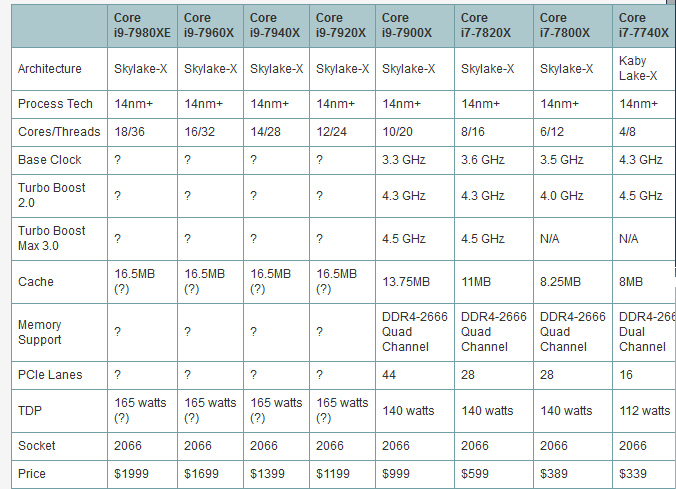
Reasons to choose core i9!
- The Core i9 will include an unprecedented 18-core model, in addition to 10-, 12-, 14- and 16-core versions. That refers to the number of individual processing units and means the CPU can handle more distinct tasks at once.
- These new chips include Intel’s updated Turbo Boost 3.0, which allows the CPUs to temporarily increase their power for short bursts without overheating.
- Desktops and DIY kits with Intel’s new X299 motherboard chipset will be available right away, so there’s no delay on building your own Core i9 rig.
- Intel designed a new liquid cooling system, called TS13X to keep these 140-watt TDP chips under control (but you’ll have to buy it separately for about $100).
- Intel says these will be up to 15-percent faster than the former enthusiast CPU family, Broadwell-E.
However you can aslo visit this link to compare the desktop grade i7 with new i9.
X Series!
The next CPU down the stack is compelling as well. The Core i7-7820X is the new 8-core / 16-thread HEDT option from Intel, with similar clock speeds to the 10-core above it, save the higher base clock. It has 11MB of L3 cache, 28-lanes of PCI Express (4 higher than Broadwell-E) but has a $599 price tag. Compared to the 8-core 6900K, that is ~$400 lower, while the new Skylake-X part iteration includes a 700 MHz clock speed advantage. That’s huge, and is a direct attack on the AMD Ryzen 7 1800X that sells for $499 today and cut Intel off at the knees this March. In fact, the base clock of the Core i7-7820X is only 100 MHz lower than the maximum Turbo Boost clock of the Core i7-6900K!
The bottom processor is the Core i7-7800X, running at 3.5 GHz with a 4.0 GHz turbo. This design will not feature Intel’s new ‘favored core’ Turbo 3.0 technology (more on that below), but will have six cores, support quad-channel memory at DDR4-2400, come in at a TDP of 140W, have 28 PCIe lanes, and retail for around $400. This processor will be the entry level model, for any user who needs the benefit of quad-channel memory but perhaps doesn’t need a two-digit number of cores or has a more limited budget.
Next up is the Core i7-7820X, which hits a potential sweet spot in the LCC design. This is an eight-core processor, with the highest LCC base clock of 3.6 GHz and the joint-highest turbo settings: 4.3 GHz for regular turbo and 4.5 GHz for favored core. Unlike the previous processor, this CPU gets support for DDR4-2666 memory.
However in another break from Intel’s regular strategy, this CPU will only support 28 PCIe lanes. Normally only the lowest CPU of the HEDT stack would be adjusted in this way, but Intel is using the PCIe lane allocation as another differentiator as a user considers which processor in the stack to go for. This CPU also runs in at 140W, and comes in at $600. At this price, we would expect it to be competing directly against AMD’s Ryzen 7 1800X, which will be the equivalent of a generation behind in IPC but $100 cheaper.
Intel Core i7x v/s Amd RYZEN
| Comparison: Core i7-7820X vs. Ryzen 7 1800X | ||
| Intel Core i7-7820X |
Features | AMD Ryzen 7 1800X |
| 8 / 16 | Cores/Threads | 8 / 16 |
| 3.6 / 4.3GHz (4.5 GHz TMax) |
Base/Turbo | 3.6 / 4.0 GHz |
| 28 | PCIe 3.0 Lanes | 16 |
| 11 MB | L3 Cache | 16 MB |
| 140 W | TDP | 95 W |
| $599 | Price (MSRP) | $499 |
The third processor is also a change for Intel. Here is the first processor bearing the new Core i9 family. Previously we had Core i3, i5 and i7 for several generations. This time out, Intel deems it necessary to add another layer of differentiation in the naming, so the Core i9 naming scheme was the obvious choice. If we look at what the Core i9 name brings to the table, the obvious improvement is PCIe lanes: Core i7 processors will have 28 PCIe lanes, while Core i9 processors will have 44 PCIe lanes. This makes configuring an X299 motherboard a little difficult.
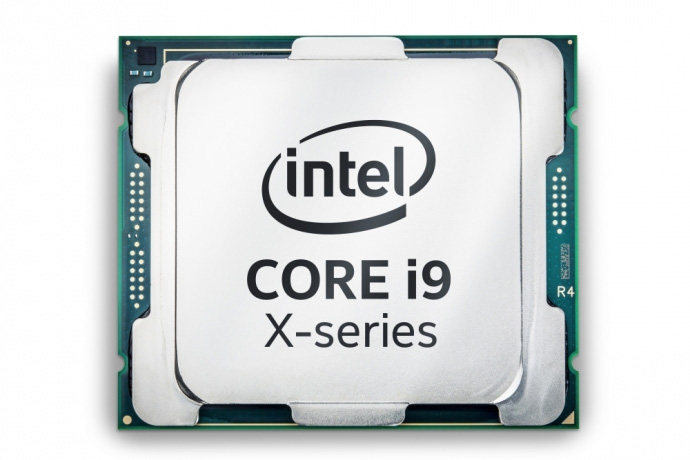
Right now the Core i9-7900X is the only Core i9 with any details: this is a ten core processor, running with a 3.3 GHz base, a 4.3 GHz turbo and a 4.5 GHz favored core. Like the last processor, it will support DDR4-2666 and has a TDP of 140W. At this level, Intel is now going to charge $100/core, so this 10-core part runs in at a $999 tray price ($1049 retail likely).
One brain cell to twitch when reading this specification is the price. For Ivy Bridge-E, the top SKU was $999 for six-cores. For Haswell-E, the top SKU was $999 for eight-cores. For Broadwell-E, we expected the top SKU for 10-cores to be $999, but Intel pushed the price up to $1721, due to the way the enterprise processors were priced. For Skylake-X, the new pricing scheme is somewhat scrapped again. This 10-core part is now $999, which is what we expected the Broadwell-E based Core i7-6950X to be. This isn’t the top SKU, but the pricing comes back down to reasonable levels.
Meanwhile for the initial launch of Skylake-X, it is worth noting that this 10-core CPU, the Core i9-7900X, will be the first one available to purch. More on that later.
Still covering the LCC core designs, the final processor in this stack is the Core i9-7920X. This processor will be coming out later in the year, likely during the summer, but it will be a 12-core processor on the same LGA2066 socket for $1199 (retail ~$1279), being part of the $100/core mantra. We are told that Intel is still validating the frequencies of this CPU to find a good balance of performance and power, although we understand that it might be 165W rather than 140W, as Intel’s pre-briefing explained that the whole X299 motherboard set should be ready to support 165W processors.
In the enterprise space, or at least in previous generations, Intel has always had that processor that consumed more power than the rest. This was usually called the ‘workstation’ processor, designed to be in a single or dual socket design but with a pumped up frequency and price to match. In order for Intel to provide this 12-core processor to customers, as the top end of the LCC silicon, it has to be performant, power efficient, and come in at reasonable yields. There’s a chance that not all the factors are in place yet, especially if they come out with a 12-core part that is clocked high and could potentially absorb some of their enterprise sales.
 Cyber Journal